Uranium-235 Fission Simulation
GEANT4 (C++) simulation of thermal neutron induced uranium-235 fission with scintillation detector readout
GitHubI was interested in the particle physics behind nuclear fission and decided to simulate the canonical reaction that lies at the core of much of the theory of nuclear fission. This reaction is the fission of a uranium-235 nucleus induced by thermal neutrons. Using the C++ package, GEANT4, which was developed by CERN to simulate high energy particle interactions with matter through monte carlo methods, I bombard a thin piece of U-235 foil with thermal neutrons, inducing the fission of the uranium nucleus. Once fission occurs, a wide spectrum of radiation is released.
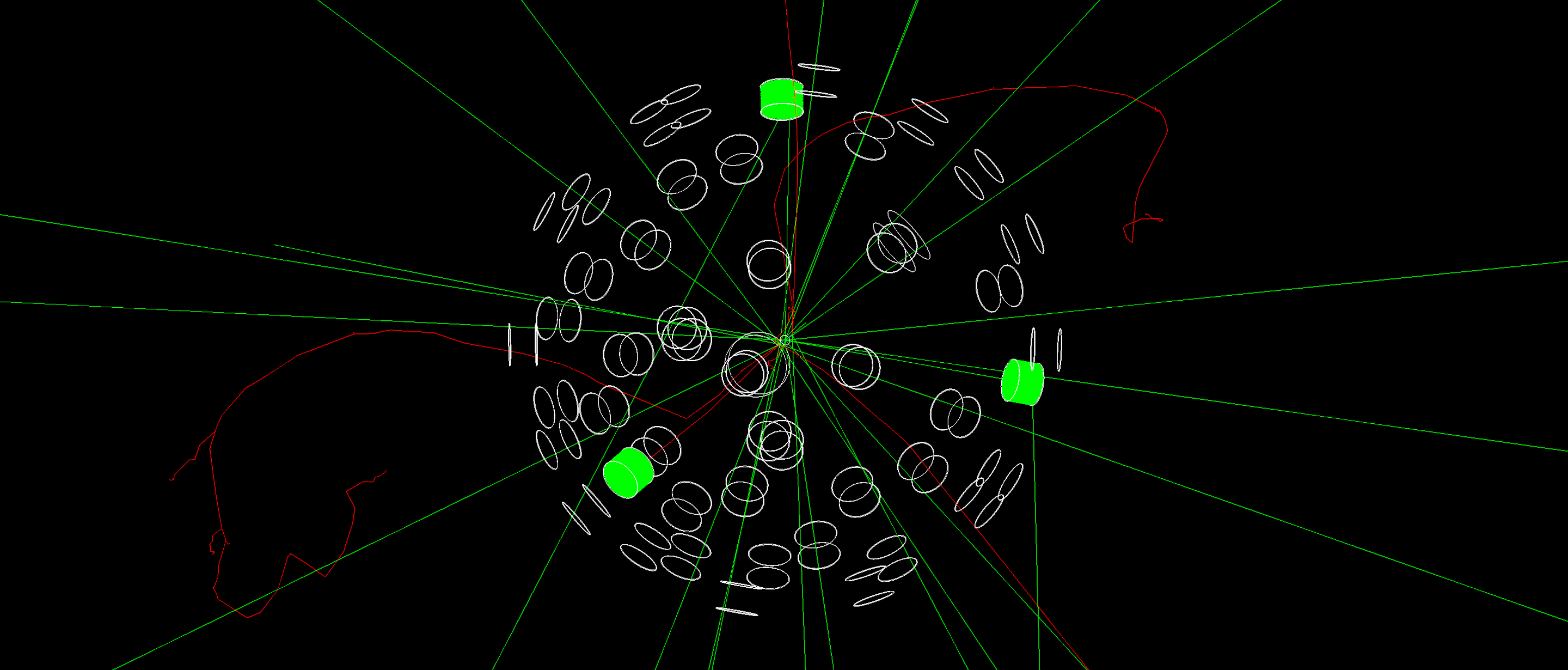
In this simulation, I have built a spherical array of particle detectors encompassing the U-235 foil to enable me to measure and analyze the radiation signature of the fission event. Specifically, I am using scintillator detectors, which are detectors built from a type of class of material that is sensitive to charged particles. When radiation strikes the scintillator, it reacts by emitting light. In the image below, we can see that three detectors have been struck by radiation and have filled up with light, shown in green.
By analyzing the pulse shape of the scintillator's response signal, I can identify the detected particle type and reconstruct the particle types and energy spectra of the radiation. This is a standard technique in experimental particle physics known as pulse shape discimination (PSD) for understanding the signal that detector is measuring. The purpose of a good detector and data aquisition system is to enable the user to accurately reconstruct the event that the detector is seeing. Doing this fully is often very difficult, or even impossible, but aiming to get as closer as possible is a useful exercise.